

1990 JAGUAR XJC CONVERTIBLE
A beautiful original XJS convertible.. Its V12 engine is as smooth as silk and propels the car rapidly down any road. The legandry Jaguar ride quality never fails to impress, even on the worst road surfaces and remains surprisingly taught, despite the lack of a roof.
With the top down on a sunny day the car comes into its own. A very special place to be and a very special 'feel good' experience that a modern car simply can not recreate.

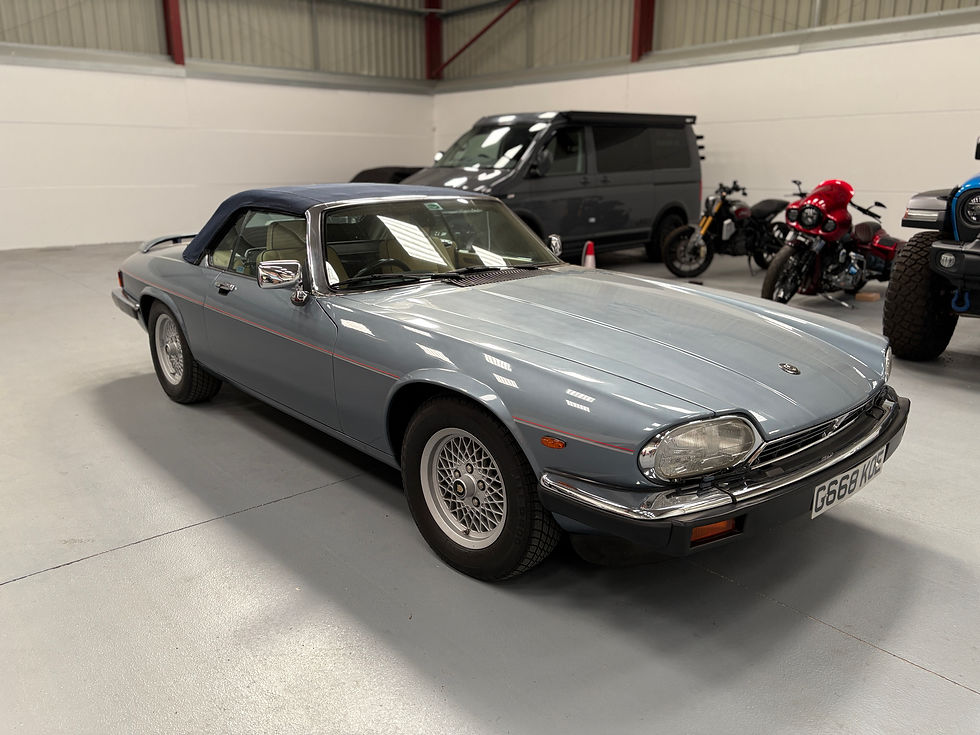
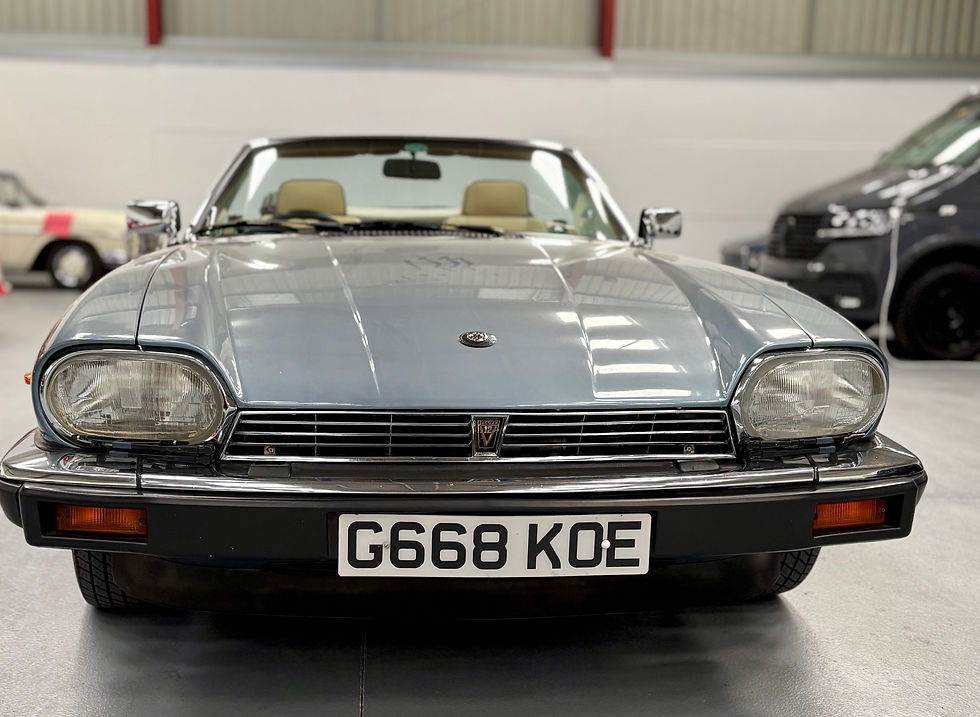
THE CAR
Pre-HE (1975–1981)
The XJ-S was introduced on 10 September 1975.[ The design and development had begun in the late 1960s by the code name of project XJ27, with an initial shape penned by Malcolm Sayer, but after his death in 1970 it was completed by the in-house Jaguar design team, headed by Doug Thorpe. The design was radical for the time, with long overhangs and the 'flying buttresses' that swept down the rear of the roofline. A common misconception of these design details is that they were a leftover from a potential mid-engine layout, with the black plastic vents behind the rear windows being functional to that design. While a mid-engine layout was considered, it never made it past initial brainstorming. The buttresses were always meant to be merely a styling feature that improved aerodynamics.
Power came from the Jaguar V12 engine with a choice of a manual or an automatic transmission, but the manual was soon dropped as they were left over from V12 E Type production. V12 powered production automobiles were unusual at the time; Italian luxury sports car makers Lamborghini and Ferrari produced such models. The specifications of the XJ-S compared well with both Italian cars; it was able to accelerate to 97 km/h (60 mph) in 7.6 seconds (automatic models) and had a top speed of 230 km/h (143 mph). The first series of XJ-S cars had a BorgWarner Model 12 transmission with a cast-iron case and a bolt-on bell-housing. In 1977, General Motors' Turbo-Hydramatic 400 transmissions were fitted. The TH400 transmission was an all-aluminium alloy case with an integrated non-detachable bell-housing. The XJ-S was originally supplied with Dunlop SP Super E205/70VR15 tyres on 6K alloy wheels; British police upgraded their Jaguars to a higher-performance 205/70VR15 Michelin XWX tyres.[8] At the end of the 1970s Jaguar started to fit the 205/70VR15 Pirelli P5. The Pirelli P5 was the tyre that Jaguar had asked Pirelli to produce to improve their luxury cars. European and Canadian spec XJ-S models were fitted with two molded headlights, while models for the US (until 1992) were fitted with four round sealed beam lights due to legislation.
Jaguar launched the XJ-S in the wake of a fuel crisis, when the market for a 5.3-litre V12 grand tourer was small. The XJ-S was a radical departure from the E-Type it replaced, having shifted from being a sports car to a GT and losing the option of a convertible roof. The buttresses behind the windows were criticised at the time as German authorities feared these would restrict rearward vision, and refused to give type approval to the XJ-S (and to the similarly designed Lancia Montecarlo) – requiring German XJ-S buyers to obtain road approval for each individual car upon registration. Sales remained stubbornly low, and production was halted for half of 1981, to allow unsold stock to be moved. Because of the slow sales, Leyland Cars had decided to discontinue the car but decided to give it another chance with a light facelift and engine revisions.
Italian styling house Pininfarina introduced a 1978 concept car based on the XJ-S, called the Jaguar XJSpider; which did not see production.
HE (1981–1991)
From July 1981, the XJ-S was renamed the XJ-S HE and received the new High-Efficiency V12 engine for much better fuel economy. A positive side effect of the more efficient "Fire Ball" combustion chamber designed by Swiss Engineer Michael May was that power output was increased to 295 hp (220 kW; 299 PS) or 263 hp (196 kW) in North America. At the same time, the XJ-S HE received changes to its exterior and interior: there was body-coloured boot trim in place of the standard previous black, new five-spoke "Starfish" alloy wheels fitted with 215/70R15 Pirelli Cinturato P5 tyres, chrome inserts on the upper part of the bumpers, and burled elm inserts on dashboard and door cappings.
Six-cylinder and convertible models
In 1983, the new 3.6-litre Jaguar AJ6 straight-six engine was introduced along with a new convertible model called the XJ-SC. The coupé's rather small rear seats were removed in order to make space for the removable soft top, making it a strict two-seater car. The XJ-SC was not a full convertible but was a fixed profile variant with a non-removable centre targa-type structure, fixed cant rails above the doors, and fixed rear quarter windows. The six-cylinder cars can be identified by a raised bonnet centre section.
Between 1983 and 1987, the six-cylinder-engined cars were only available with a five-speed manual transmission (Getrag 265), with a four-speed automatic (ZF 4HP22) offered from 1987 onwards (along with improved fuel injection as used on the XJ40). The V12 models continued to use the stronger Turbo-Hydramatic 400 transmission. The earlier manual models were not imported by Jaguar into the United States, which had to wait until the facelift manual 4-litre XJS coupé and convertible became available. A V12 powered XJ-SC was introduced in 1985.
The two-seat XJ-SC targa-type model, never a great success in the marketplace, was replaced by a two-seat full convertible in 1988 which proved to be a great hit.
Check out this 'The Next Big Thing' video from Magnus Walker Click Here